Checklist before buying network cable tester UK: UK Practical Guide
Before you buy a network cable tester in the UK, confirm it offers a clear wire-map (or pair LEDs), a remote for installed runs, and—if you work in crowded cabinets—tone/trace support, plus a workable UK warranty and access to spare remotes.
Direct answer checklist
Use this short list when comparing continuity-class LAN testers for UK sites, cabinets and patch leads:
- Wire map or pair LEDs — you need an unambiguous pass/fail view of pairs, not a vague “link OK” light alone.
- Remote included — essential for wall plates, floor boxes and any run you cannot loop at the far end by hand.
- Tone/trace mode — helpful when labels are missing and cabinets are messy.
- UK aftercare — check warranty cover and whether spare remotes are realistically available if one goes missing on site.
- Match the tool class to the job — for everyday open/shorts and miswires, a continuity-style wire-map kit is usually enough; do not assume Cat6A certification or advanced length mapping unless the seller clearly documents those capabilities.
UK buying guides consistently favour testers that combine accurate wire mapping, straightforward fault finding and sensible value for the work you actually do.
Pre-checks
Complete these checks before you pay:
- Job scope — patch leads only, installed structured cabling, or mixed site work? Installed runs almost always need a remote.
- Connector set — confirm RJ45 (and any other connectors you truly need) are stated for the kit you are buying; do not infer extras from photos alone.
- Kit contents — main unit, remote, leads and basic instructions should be listed; treat packing lists that are missing or unclear as incomplete until confirmed.
- Training readiness — decide who will use the tester and that they understand wire-map results versus certification reports.
- Aftercare in the UK — note the retailer’s warranty terms and how you would replace a lost remote.
- Feature honesty — if you need PoE voltage checks or TDR-style length measurement, verify those functions are explicitly specified for that model; many continuity kits do not include them.
Red flags to stop
- Claims of Cat6A certification or precise length mapping on a basic continuity/wire-map tool without clear documentation.
- Marketing that invents PoE testing, brand warranties or performance figures you cannot see on the product page.
- No remote for installed-cable work, or no plan to buy a compatible spare.
- Unclear wire-map readout (no display and no clear pair LEDs).
- Missing UK warranty path or “as seen on marketplace” copy that conflicts with the model you are actually being sold.
- Pressure to treat a continuity tester as a full certification instrument.
Record-keeping tips
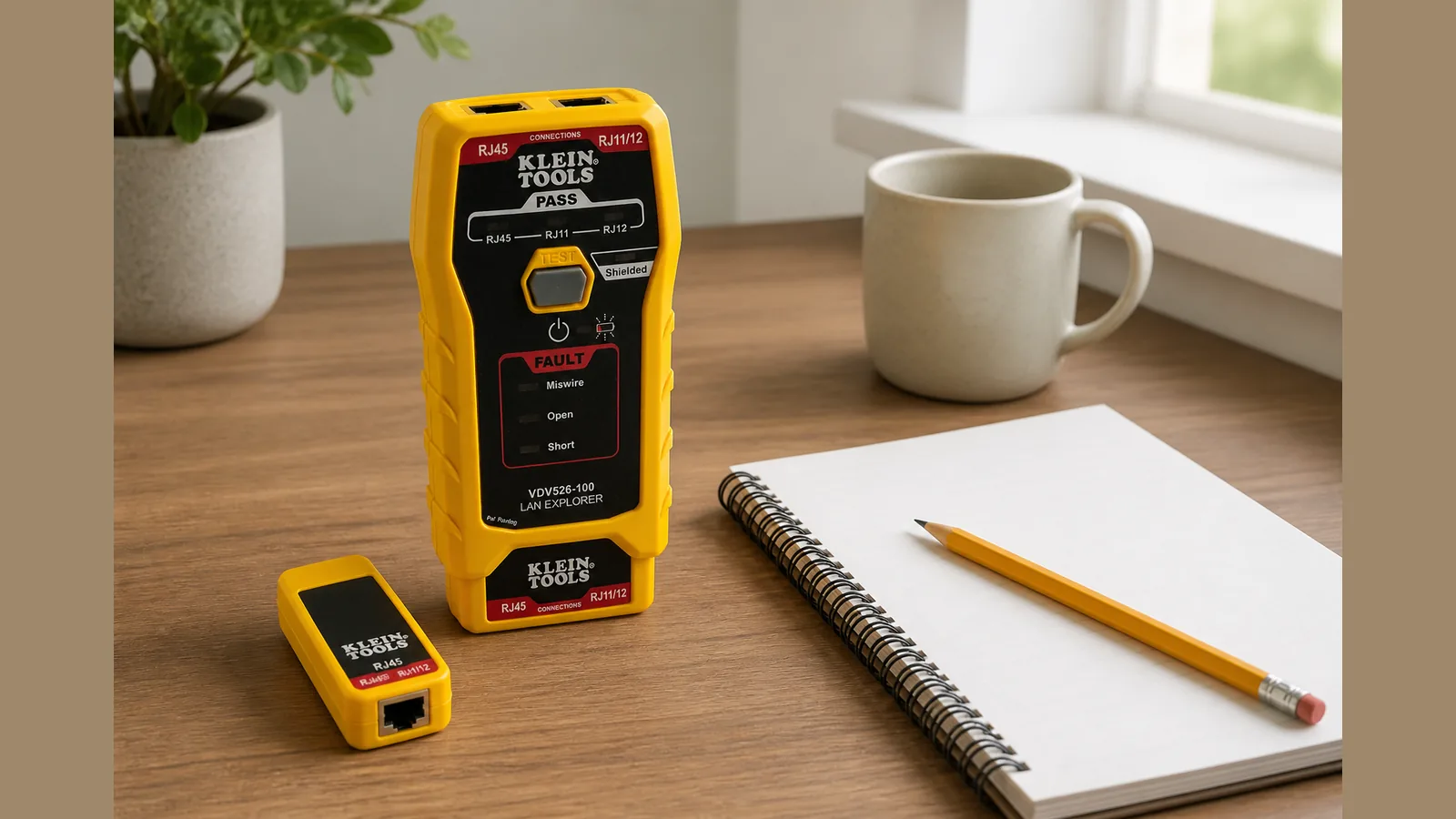
- Note the exact model (for example, Klein Tools VDV526-100 when that is the SKU you intend to buy) and keep the order confirmation.
- Record which remote ID or kit was used on each job, and where spare remotes are stored.
- Log simple outcomes: pass, open, short, miswire—and the cable ID or room label.
- Photograph the wire-map result only when your site policy allows; do not rely on memory after a busy cabinet visit.
- Separate “continuity checked” notes from any third-party certification paperwork so clients are not misled.
Next step
If you want a continuity-class LAN / network cable tester supplied with a remote for UK site checks, review the Klein Tools VDV526-100 cable tester product details and confirm the kit matches your checklist before ordering.
FAQ
What should a network cable tester first-use checklist UK teams follow?
Fit batteries if required, confirm the remote pairs with the main unit, test a known-good patch lead, then try one labelled installed run end-to-end. Stop and recheck leads if results look inconsistent.
What belongs on a network cable tester kit contents checklist?
Main unit, remote, interconnect leads, and basic operating notes. Add spare remote availability and retailer warranty to your buying checklist, not only the box contents.
Is a network cable tester training checklist UK-specific?
The electrical basics are universal, but UK teams should also cover site labelling habits, when to escalate beyond continuity tests, and how your supplier’s warranty and spare-parts route works.
Do I need PoE or TDR features?
Only if your jobs require them. Some UK guides recommend kits that combine RJ45 wire-map continuity with PoE voltage detection and TDR length measurement; many buyers only need clear wire mapping and a remote.