How a network cable tester works UK: UK Practical Guide
How a network cable tester works UK, in plain terms, is simple: it checks whether the conductors in a network cable form complete, correctly wired paths so an Ethernet signal can travel without shorts or unwanted connections—typically as a continuity-style check rather than a full performance laboratory test.
Plain-English definition
A cable tester is an electronic device used to verify the electrical connections in a signal cable or other wired assembly. Basic cable testers act as continuity testers: they confirm a conductive path between the ends of the cable and that the wiring pattern is correct.
For network work, a network cable tester checks whether the cable can carry an Ethernet signal in the sense that all circuits are closed and current can flow without short circuits or unintended cross-connections. That is the core idea behind how a network cable tester works UK installers and technicians usually need on site.
Industry guides also describe network cable testers as essential tools for engineers and technicians who need to confirm connectivity and reliability on wired Ethernet links before blaming switches, routers or software.
How it relates to the job
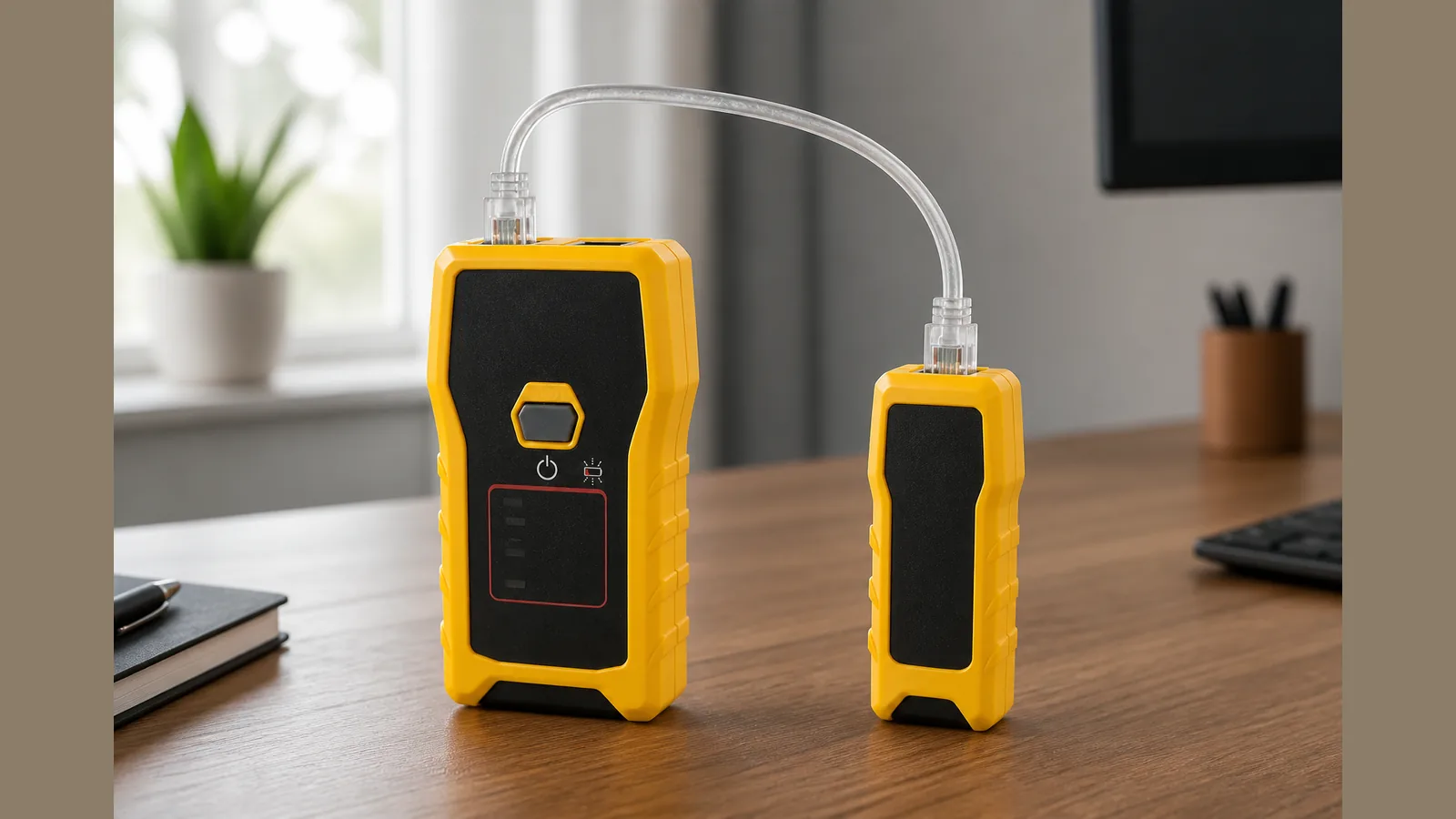
On a UK job—home office runs, small-office patching, or fault-finding after a retermination—you typically connect the main unit at one end and a remote at the other. The tester then indicates whether pairs are continuous and mapped as expected.
- Confirm a new RJ45 termination before you close trunking or ceiling tiles.
- Separate a bad cable from a bad port when a link light fails.
- Catch crossed pairs, opens and shorts that a visual check will miss.
A practical checklist before buying network cable tester UK gear should focus on whether you need a main unit plus remote for two-ended checks, clear pass/fail indication, and a form factor you can carry between floors. When you choose the right size network cable tester UK teams actually use day to day, favour something compact enough for a toolbag, with a remote that is easy to leave at the far outlet.
One product projection in this category is a Klein Tools VDV526-100 LAN / network cable tester with remote—useful as an example of a continuity-class kit with a separate remote, not as a certified certifier.
What not to invent
Common mistakes using network cable tester UK buyers make include treating a basic continuity or wiring check as proof of category performance. Avoid these traps:
- Do not assume Cat6A (or any category) certification from a continuity-class result alone.
- Use confirmed details length-mapping accuracy, PoE test features, or brand warranty terms that are not documented for the exact unit you hold.
- Do not confuse “the pairs ring through” with “the link will meet a lab or standards body’s performance grade.”
Use the tester for what it is: confirming conductive paths and correct wiring so you can trust the physical cable before you escalate to higher-tier instruments or replace active equipment.
UK framing
In the UK market, the practical question is usually “will this patch lead or permanent link wire correctly end to end?” rather than “can I issue a formal acceptance certificate?” Continuity-class network cable testers suit that first-line check on Ethernet copper runs in homes, shops and light commercial spaces.
Keep buying decisions grounded: match the tool to two-ended testing with a remote, keep expectations at wiring integrity, and leave category certification, advanced length claims and PoE validation to instruments specified for those jobs.
Next step
If you want a straightforward LAN / network cable tester with remote for basic continuity and wiring checks, see the Klein Tools VDV526-100 cable tester product details and confirm the kit matches your site workflow before you buy.
FAQ
Does a network cable tester prove Ethernet speed?
No. A typical network cable tester confirms closed circuits and correct wiring so a signal path exists; it does not, by itself, prove category performance or negotiated link speed.
Why use a remote unit?
A remote at the far end lets you verify the full cable path between two connectors—exactly the check you need after terminating both ends of a run.
What should a UK buyer check first?
Use a short checklist before buying network cable tester UK models: two-ended testing support, clear indication of opens/shorts/miswires, and a size that fits how you work on site—then keep claims limited to continuity-class capabilities.